
Best For
Teams this article is built to help
Category: Parent Resources
Evidence
What backs this guide
Curated references are cited at the end of the article.
Materials
What you can leave with
- Condensed key takeaways
- 2 bonus downloads
- Interactive self-check quiz
Thanksgiving week is here, and for many families that means a full week at home, a few school weeks, and then winter break. For a child with a behavior plan, the stretch from Thanksgiving to New Year's can feel like one long change in routine. The good news is that you do not need to hold every routine steady. Keep three anchors (sleep, meals, and a predictable start to the day), show your child what is coming, plan a break space and an exit before every gathering, give relatives one specific job, and jot a few notes to share with school in January. This guide walks through each piece.
Why the Holidays Are Hard
Your child's behavior plan was built around a school day: known adults, a set schedule, familiar spaces, and clear ways to ask for help. The holidays change almost all of that at once.
What Changes
- Travel: long car rides, airports, waiting with little to do
- Visitors: crowded rooms, new faces, expected hugs
- Noise and light: music, cooking, decorations, many voices
- Food: unfamiliar dishes and mealtimes that shift
- Late nights and early mornings
- Gifts: waiting, sharing, and disappointment
- Moving between two homes, or a change in who is caring for your child
What It Can Look Like
- Old behaviors your child had outgrown come back
- Shorter fuse late in the day
- Hiding, running off, or refusing to join in
- Big reactions to small changes in plans
- Trouble falling asleep after busy days
None of this means the plan stopped working or that your child is "being bad." Behavior tells us something. A child who usually asks for a break at school might scream instead when they are tired, hungry, in a loud room, and missing the break card they use every day. Background conditions like poor sleep or a crowded house do not cause a behavior on their own, but they make hard moments more likely. That is why the most useful holiday supports are small changes to the day, made before anything goes wrong.
Keep Three Anchor Routines
Trying to keep every routine during the holidays sets everyone up for frustration. Instead, choose a few anchors and protect them on most days.
Three Anchors Worth Protecting
Sleep
The American Academy of Sleep Medicine recommends 10 to 13 hours per 24 hours (including naps) for ages 3 to 5, 9 to 12 hours for ages 6 to 12, and 8 to 10 hours for teens. Regularly sleeping less than that is associated with attention, behavior, and learning problems (Paruthi et al., 2016). Choose a bedtime window and keep it on most nights. When a late night happens, plan a slow morning the next day.
Meals and snacks
Holiday meals often run late. Keep regular snack times, and bring one familiar food to every gathering so your child is never stuck choosing between hunger and a plate of new things.
A predictable start to the day
Keep the first few steps of the morning the same, even on holidays: wake up, get dressed, breakfast, then look at the plan for the day. A familiar start gives your child something solid before everything else changes.
Visual Schedules and Countdowns
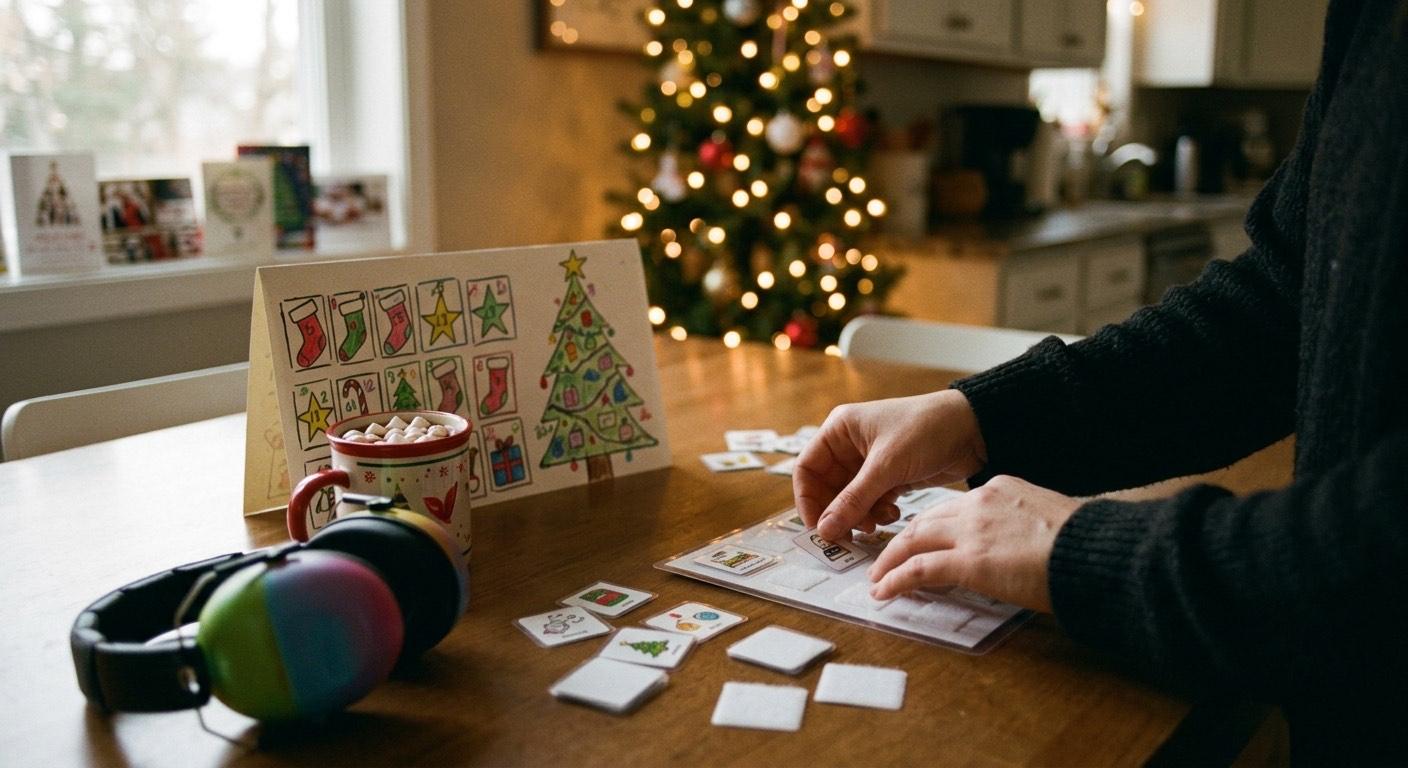
Many of the surprises that lead to holiday meltdowns are surprises only to the child. Adults know Aunt Rosa's family arrives at noon and that dinner is at four. A visual schedule puts that plan where your child can see it.
There is solid research behind this. A review of studies on visual activity schedules concluded that they meet criteria for an evidence-based practice for people with autism (Knight et al., 2015), and a large review of autism intervention research lists visual supports among its evidence-based practices (Hume et al., 2021). That research focused on autistic children, but making the day visible is a low-effort support families can try whatever their child's diagnosis.
- Day schedule: a short list or row of pictures for the day, with a check mark as each part ends. Include the fun parts and the quiet breaks, not only the demands.
- Countdown calendar: a paper calendar that marks home days, visit days, travel days, and the first day back at school. Cross off each day together.
- Mark changes: when plans change, change the schedule with your child instead of only telling them.
- Borrow from school: if your child's classroom already uses a picture or written schedule, ask the teacher for a copy or the same picture style.
Preview New Places and People
Researchers have studied a version of this called priming: showing a child what is coming before it happens. In one small classroom study, two students with autism previewed their school assignments before class, and on those days problem behavior went down while academic responding went up (Koegel et al., 2003). A holiday preview applies the same idea to places and people.
A Five-Part Preview
- Where: photos of the house or venue, including the room where your child can take a break
- Who: photos of the people who will be there, with names
- What happens: what comes first, what comes last, and roughly how long you will stay
- How to say hello: let your child choose a wave, a high five, or a hug, and tell relatives the choice is your child's
- What will be different: a pet, a long table, a loud game on TV, food they have not tried
Keep the preview short and matter-of-fact, and repeat it the morning of the visit. If you are traveling, preview the trip too: the car seat or airplane seat, the snack bag, and what your child can do while waiting.
Plan a Break Space and an Exit
Every gathering needs two plans made in advance: where your child can go to calm down, and how your family leaves if staying stops working.
- Pick the break space before you arrive. A spare bedroom, a quiet corner, or the car with a parent. Show it to your child early in the visit, not in the middle of a hard moment.
- Pack a break bag. Headphones, a favorite small toy, a familiar snack, a fidget, or a book.
- Use the school's break signal. Ask your child's team what words, card, or gesture your child uses to ask for a break at school, and honor that same request at the gathering.
- Agree on an exit signal. Decide with your partner or another adult how you will signal that it is time to go, and who will leave with your child.
- Bring the safety plan. If your child has a crisis or safety plan, bring it and tell one trusted adult at the gathering what it says.
Leaving Early Is Part of the Plan
Going home after the meal, before the gift exchange gets loud, is not a failure. It is the plan working. A short visit that ends well is often better for everyone than a long one that ends in tears.
Gifts deserve their own plan. Waiting while others open presents, a gift that was not the one they hoped for, or a cousin playing with a brand-new toy can all be hard. Practice taking turns opening at home, decide ahead of time where new things will be kept safe, and give your child a simple line to use ("Thank you, I'll look at it later").
A Short Script for Relatives
You do not need to explain the whole behavior plan at the door. A two-sentence summary and one specific job usually work better than a long talk. Consider a hypothetical eight-year-old we'll call Eli:
"Eli does best when he gets a heads-up before things change, and when he can take a break in the back bedroom. If you see him heading there, let him go. He'll come back when he's ready."
"Could you be the one who gives him a five-minute warning before dinner?"
Have this conversation before the visit, by phone or text, not in the middle of the gathering. For relatives who push back or have strong opinions, our guide to explaining behavior plans to extended family has scripts for the most common reactions.
A Simple Home Log for January
When school starts again, your child's team will look at their data and wonder what changed over the break. Your notes give them the context they cannot see. You do not need school-style data sheets. A few lines a day in a notebook or on your phone is enough:
- Sleep: roughly when your child went to bed and woke up
- Big events: travel, visitors, a party, a change in caregivers
- One thing that went well
- Any hard moment: what happened right before, what your child did, and what helped
That last line is the same before, during, and after pattern the school team uses, written in your own words. The school version of tracking background factors is the setting events checklist, and it can give you ideas for what to note. In the first week of January, send the teacher a short summary or bring your notes to the next meeting. If your child's school sends parent reports, such as the scheduled email summaries some teams send from Classroom Pulse, the first report after break is a natural time to compare what you saw with what they see.
If your child does not want to go back once break ends, our guide to school avoidance after winter break covers the first mornings and how to work with the school team.
Taking Care of Yourself
Parents of children with behavior plans often spend the holidays scanning the room, managing relatives, and heading off hard moments, all while trying to make the season special. That is a lot.
- Trade shifts with your partner or a trusted relative so each adult gets real time off.
- Lower the bar on something else: store-bought pie, fewer cards, a smaller gathering.
- Choose one thing you will protect for yourself each week, even if it is twenty minutes.
- Say no to gatherings that cost your family more than they give.
For more on this, see self-care for parents of children with behavior plans. If you want to keep skills going over longer breaks, the ideas in our summer continuity guide work for winter too, and more guides for families are on our parent resources page.
Frequently Asked Questions
Should we keep using the behavior plan over break?
Use the parts that fit home life: the break signal, praise for the skills your child is learning, and any visual supports. Ask the team which one or two strategies matter most at home. You do not need to run the plan exactly as school does.
What if my child melts down at a relative's house?
Use your break space and exit plan. Keep everyone safe, talk less, and move your child somewhere quieter. Leaving is fine. Later, jot down what happened right before and what helped, so you can plan the next visit.
Will one late night undo everything?
No. One late night is manageable. Plan a slower morning, keep the anchors, and return to the usual bedtime window the next night. It is a pattern of short sleep, not one evening, that is linked to more behavior and attention problems.
Should I tell the school how break went?
Yes. A few lines in early January about sleep, big events, and any hard moments help the team understand their first weeks of data.
Pick Your Anchors Tonight
You cannot control every part of the holidays, and you do not need to. Choose your three anchors, make a countdown, preview the first big visit, and plan the break space and the exit. Those few steps carry a lot of weight.
If you want a simple way to note sleep, visitors, and other background factors at home, this printable tracking sheet is a good starting point.
References
Hume, K., Steinbrenner, J. R., Odom, S. L., Morin, K. L., Nowell, S. W., Tomaszewski, B., Szendrey, S., McIntyre, N. S., Yücesoy-Özkan, S., & Savage, M. N. (2021). Evidence-based practices for children, youth, and young adults with autism: Third generation review. Journal of Autism and Developmental Disorders, 51(11), 4013-4032. https://doi.org/10.1007/s10803-020-04844-2
Knight, V., Sartini, E., & Spriggs, A. D. (2015). Evaluating visual activity schedules as evidence-based practice for individuals with autism spectrum disorders. Journal of Autism and Developmental Disorders, 45(1), 157-178. https://doi.org/10.1007/s10803-014-2201-z
Koegel, L. K., Koegel, R. L., Frea, W., & Green-Hopkins, I. (2003). Priming as a method of coordinating educational services for students with autism. Language, Speech, and Hearing Services in Schools, 34(3), 228-235. https://doi.org/10.1044/0161-1461(2003/019)
Paruthi, S., Brooks, L. J., D'Ambrosio, C., Hall, W. A., Kotagal, S., Lloyd, R. M., Malow, B. A., Maski, K., Nichols, C., Quan, S. F., Rosen, C. L., Troester, M. M., & Wise, M. S. (2016). Recommended amount of sleep for pediatric populations: A consensus statement of the American Academy of Sleep Medicine. Journal of Clinical Sleep Medicine, 12(6), 785-786. https://doi.org/10.5664/jcsm.5866
Put This Into Practice
Turn the article into action with ready-to-use materials. Downloads stay open; emailed resources and quiz results are opt-in.
Key Takeaways
- You do not need to keep every routine. Protect three anchors: sleep, meals and snacks, and a predictable start to the day.
- Regularly sleeping less than recommended is associated with attention, behavior, and learning problems, so keep a bedtime window on most nights.
- Visual schedules and countdown calendars make the plan visible; research with autistic children supports visual supports as an evidence-based practice.
- Before each gathering, preview the place and people, pick a break space, and agree on an exit plan. Leaving early is part of the plan.
- Keep a few lines a day about sleep, big events, and hard moments, and share them with your child's team in January.
Bonus Materials
Clean downloads to pair with this article
Download resources directly or send a copy to your inbox. Marketing updates are optional.
Setting Events Tracking Sheet
A printable checklist for noting sleep, meals, and other background factors that affect behavior
Break and Transition Toolkit
Transition strategies such as advance warnings, previews, visual supports, and break requests
Is Your Holiday Plan Ready?
Four quick questions to check your plan for routines, visits, and hard moments between Thanksgiving and New Year's.
For families
Stay Connected With Your Child's School Team
Some school teams use Classroom Pulse to send families scheduled email summaries of behavior data.
Explore Family ResourcesAbout the Author
Bobby Hillman is a Board Certified Behavior Analyst and Licensed Behavior Analyst with an M.Ed. in Special Education and more than 25 years in public special education and autism services. He works as a Behavior Instructional Specialist and founded Classroom Pulse to reduce the documentation load on classroom teams while keeping the detail FBA and BIP work requires.
About Classroom PulseRelated Articles
Reading Your Child's IEP Progress Report on a Behavior Goal
A plain-language guide for families: what progress report codes usually mean, the data behind the rating, questions to ask, and what should happen when progress is not enough.
Class Parties, Costume Days, and Assemblies: Planning Behavior Support
Event days stack changed routines, noise, costumes, food, and thin adult structure. Plan them like a new routine, staff them like a transition, and tag them in your data.
Function-Based Parent Communication: Explaining Behavior Without Blame
Families deserve behavior updates that are honest, understandable, and useful. Learn how school teams can explain behavior patterns, functions, and progress data without making parents feel blamed.